
 “I can’t take it!” My friend Sophie is on the verge of breaking up with her boyfriend (again). He’s a truly sweet guy and they seem to adore each other, but periodically something triggers deep pain for Sophie, and when she tries to fix the feelings by talking to him, all hell breaks loose.
Have you ever decided to “have a talk” with someone about what you want, and ended up pushing them further away from you, making them LESS likely to meet your needs? Despite our highest intentions, many of us – even those who have taken classes and read books on communication – get stuck in self-defeating cycles and disappointing outcomes.
I take it as a good sign that Sophie called me, because even though she feels like throwing her relationship in the toilet right now, she knows I will try to talk her out of it.
She and I have been discussing this, and she knows I get it. I understand that pain, pain from past trauma – that when it is triggered, can make a person lash out and sabotage a relationship, just to relieve the internal anxiety and distress.
Having just surfaced from a life-changing book: Secure Relating: Holding Your Own in an Insecure World, I feel I have something to offer Sophie at this moment. In their powerful treatise, authors Sue Marriott, LCSW, CGP and Ann Kelley, PhD, lay out a compassionate roadmap for bringing safety into communications; a way to help people talk through their big feelings without hurting each other or their relationships in the process.
The authors have synthesized the vast body of existing scientific data on attachment and trauma, and they offer a user-friendly guide to show us how we’re going astray in our important communications AND how we can create more safety, to enjoy the loving connections we deeply yearn for.
So, when Sophie calls me in this volatile, sabotaging state, I use the book like the jaws of life, like a crash cart to bring her back from the edge. And it works!
Before I describe HOW the book helped, let me share some basic cliff notes. Marriott and Kelley have integrated modern attachment theory + relational neuroscience to offer something new: the Modern Attachment Regulation Spectrum (MARS) – a framework built on the idea that attachment isn’t a fixed diagnosis but a shifting state. They offer a color system to help people identify both their own and their partners’ attachment tendencies. Keep in mind that the authors refer to these color states as fluid and changeable, not labels to diagnose ourselves with.
Blue represents the propensity to avoid or downplay emotions. Those of us who lean Blue may have learned to deal with distress by turning down the volume on feelings and being self-reliant. You might lean Blue if you tend to shut down when other people get upset. If you’re in a conflict with someone on the Blue-leaning side, you may notice that they get colder and avoid eye contact.
Red describes the anxious response of turning up the volume on emotions when feeling hurt or abandoned. People who lean Red when feeling threatened will up the ante emotionally and feel an urgency to resolve their hurts. You may identify with Red if you feel the consuming urge to resolve a conflict and the inability to focus on anything else until you do. In a heated conversation with someone in Red activation, you may notice them getting more intense, accusatory and intimidating.
There is also a “Tie Dye” designation, associated with “disorganized” attachment, which you can learn more about in the chapter 6 of the book.
The promised land is the “Green Zone.” The Green Zone is the space between Blue and Red polarities, where we have a sense of connection and “felt safety.” This Green “window of tolerance,” first termed by Dr. Dan Siegel in his book The Developing Mind, is what we want to stretch and expand in ourselves over time.
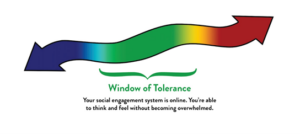
Despite our early traumas, and whichever color we lean toward, most people are fairly reasonable most of the time. However, it’s the moments when you and your partner are both triggered and seeing through Red and/or Blue glasses, that you can become completely unreasonable and wreak havoc on the feelings of trust and safety between you.
Back to Sophie: Because she seemed to be in a “Red activation” spiral, I pulled out the book and found chapter 9: “Cooling Down Red Activation.” I literally read the chapter to her over the phone. With each paragraph, her breathing slowed. Within 20 minutes, she had calmed down and was back into Green Zone territory, where she could consider her boyfriend’s feelings as well as her own, and the whole picture.
It was like a freaking miracle. But it wasn’t magic; It was science that Marriott and Kelley explain in simple, understandable terms in their book.
I’m happy to say that Sophie and her boyfriend are doing well, working together to create more security in their relationship. I personally think Secure Relating: Holding Your Own in an Insecure World is essential reading for anyone who struggles with communication in their relationships. And don’t we all, at times?
Here are 5 tips I learned from the book about how to nurture safety in communications:
- Take a break to calm down. If you start to sense negative emotions building in yourself or the other person during a conversation, take a break before continuing. Walking is rhythmic and predictable and can help calm your brain down. You can also use the SIFT tool to get present and back to the Green Zone:
- Notice physical SENSATIONS you’re feeling, like the soles of your feet on the ground, or a breeze on your face.
- See if any IMAGES come to mind, vivid or fleeting.
- Notice your FEELINGS and name them.
- Be aware of your THOUGHTS without letting them carry you away.
- Use breath to modulate your reactions. Marriott and Kelley suggest that if you lean Blue and you notice you’re getting impatient or shut down, focus on inhaling to add oxygen and gather your energy. If you lean Red and you feel powerful emotions building with an urgency to “do something,” focus on long, slow exhales to bring your activation down. If all that is too much to remember, they recommend a fake yawn! It will turn into a real yawn and help disarm the limbic activation. Even a minute of this intentional breathing can interrupt the cascade of physiological defenses.
- Engage your prefrontal cortex. You can use the more rational part of your brain to imagine yourself being how you WANT to be. Picture yourself being the best version of you, with all your strength and generosity. Or you can imagine your partner as a child, genuinely hurt, and know that’s the source of their distorted reactions. By using your PFC this way, you calm down the more primitive and defensive amygdala.
- Soothe your partner’s activation. If your partner is seeing through Red glasses (Red activation) and feeling hurt, slighted or abandoned, move toward them physically. You can reassure them in straightforward language like “I’m here” and “I’m glad you’re telling me this.” If your partner is Blue activated and feeling trapped, grant them space to leave the room for a bit if they feel they need time to regroup.
- Show care. Send signals of safety by speaking with kindness and respect. For a partner in Red activation, they may be sensitive to feeling abandoned, so warm up your facial expressions and tone of voice. For a partner with Blue activation, “statements of credibility” may help them to remember you see the good in them and deactivate their clamming up. If it feels authentic, you can preface difficult information by affirming what they are doing well.
- Explore. Perhaps the most powerful tool we have is to bring a sense of curiosity and care to what’s happening inside of us. If we have resistance to feeling uncomfortable, that can keep us stuck in miserable cycles. Our avoidance of conflict can euthanize the love in our relationships. As the authors state, “If we believe we aren’t supposed to feel discomfort, we will naturally try to avoid it. However, by giving ourselves permission to have distress and cultivating pride in being able to tolerate it without losing our thinking, we are more likely to be able to sit in discomfort and explore it.” The better able we are to explore our uncomfortable states while they’re happening, the wider we grow our beautiful Green window of tolerance.
Safely inside the window of tolerance, we can be in touch with our own feelings and wants but also see and hear what’s important to our partner. This is secure relating.
These tools of secure relating can be used with anyone in your life, not just romantic partners. In turbulent times, it’s hard to imagine skills that could be more important. Possessing the ability to promote the feeling of safety wherever you go transforms not only your own experience but ripples outward to affect the people in your life.
Sue Marriott and Ann Kelley will be presenting a free Webinar on March 12, titled Myths of Attachment: What the Real Science Tells Us. Learn more here.
Explore Secure Relating: Holding Your Own in an Insecure World.
Explore The Developing Mind: How Relationships and the Brain Interact to Shape Who We Are.